Upgrading Insulation in Midwest City’s Tinker-Era Ranch Homes
Midwest City was laid out from the 1940s as a planned community for people working at Tinker Air Force Base, and much of that first housing still stands. Small brick and frame ranch homes with thin attics and aging ductwork are the city’s signature, and they reward careful attic and duct work.
At a Glance
- Permits issued by
- City of Midwest City
- From central OKC
- About 15-20 minutes east on I-40
- Main ZIP codes
- 73110, 73130
The Homes and Buildings in Midwest City
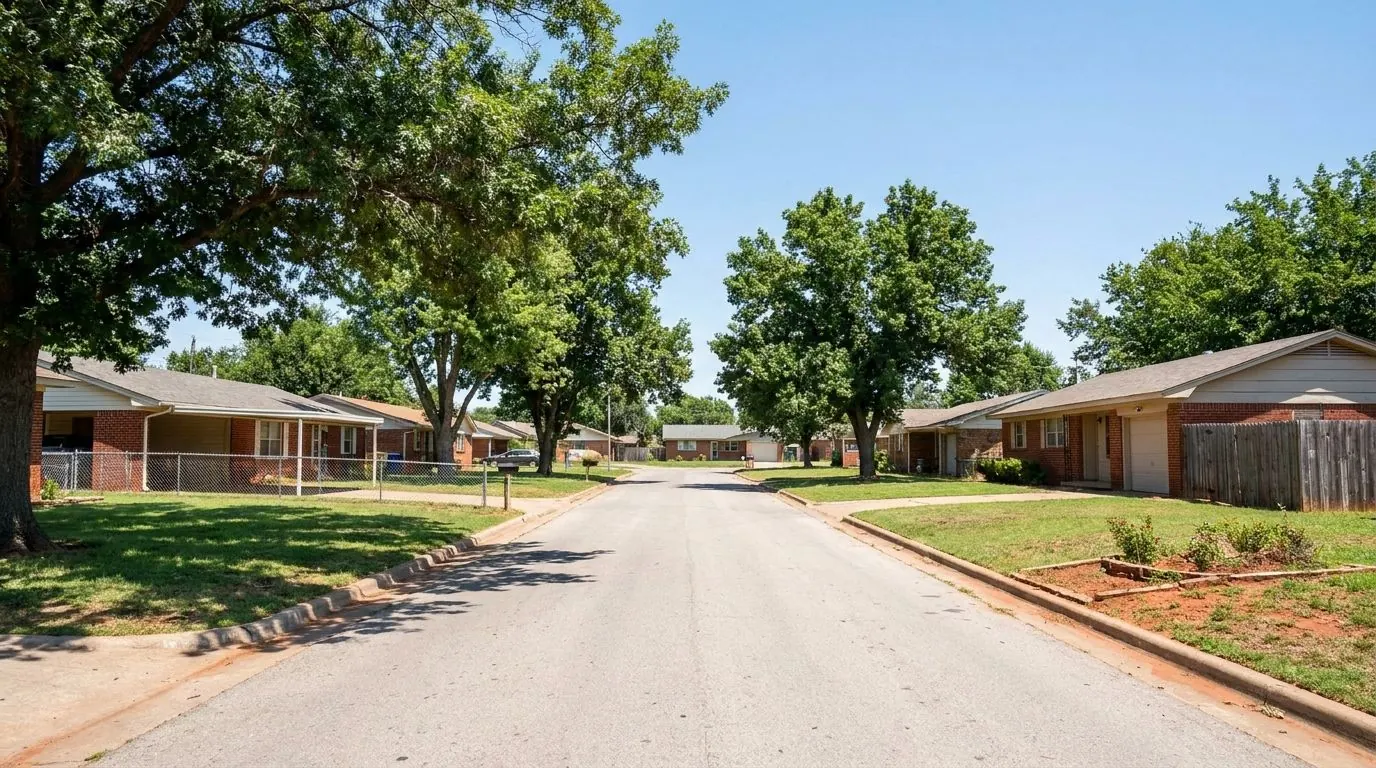
The original neighborhoods were built quickly and to a budget, as housing for a large workforce. A typical house from the 1940s through the 1960s is a compact single-story ranch, brick or frame, on a slab or a shallow crawl space, with a low-pitched roof and a shallow attic. Attic insulation from that era was thin to begin with, and decades of settling, roof repairs and wiring changes have often left bare spots between the joists. Low roof pitch also makes the eaves tight, so getting baffles in and fill out to the edge of the ceiling takes more care than in a newer house with a taller attic.
Ductwork is the other recurring issue. Some of these homes likely had central air added after they were built, with ducts run through the attic wherever they fit. Joints are often taped with material that has dried out and let go, boots are rarely sealed to the ceiling, and the duct insulation is thin or missing. In a Midwest City summer, cold supply air in an uninsulated duct crossing a hot attic both loses capacity and sweats, and the dripping can stain ceilings. Sealing and wrapping those runs is a modest job that often matters as much as the attic layer itself.
Some older attics here may also hold vermiculite, a grey-brown or gold pebble-like fill that may contain asbestos. If we find it, we stop, leave it undisturbed and recommend testing and licensed abatement before any other attic work. Areas such as Soldier Creek and the streets around the Town Center include later housing too, and where homes are newer, attics tend to be taller and easier to work in.
Neighborhood Notes
Original neighborhoods near Air Depot Blvd
The planned 1940s–60s core built for Tinker workers. Small ranches with shallow attics, thin insulation and added-on ductwork. Air sealing, duct sealing and a blown-in top-up are the usual package, after a check for vermiculite.
Town Center and Rose State College area
A mix of older homes and newer commercial and residential development around the Town Center. Commercial work here can include duct insulation and firestopping, while nearby homes vary widely in age and need.
Soldier Creek
Homes here vary in age. Where a house is newer than the original core, with a taller attic and better insulation levels, the useful work tends to be sealing attic HVAC platforms and boots and fixing specific hot rooms.
Older rental ranch homes
Some small ranches in the city are now rentals. For a landlord, a sealed ceiling with fresh depth above it is a durable, low-maintenance upgrade. Expensive wall work on a small rental is often hard to justify.
Permits in Midwest City
Authority having jurisdiction: City of Midwest City
Building permits for Midwest City addresses come from the City of Midwest City. If our work sits inside a larger permitted job, such as a remodel that opens walls or a room addition, the insulation is checked within that job’s inspections. On its own, an attic or duct upgrade may or may not need a permit, and that call is the City’s. Del City is a separate neighboring city with its own office. For a house beyond the city line in unincorporated Oklahoma County, ask the county.
What Midwest City Homes and Buildings Need Most
Blown-In Cellulose Attic Top-Ups
Borate-treated cellulose blown over thin attic fill toward an R-49 benchmark.
Attic Air Sealing & Penetration Proofing
Hand-sealing attic penetrations, top plates, duct boots and the HVAC platform.
Ductwork & HVAC Thermal Wrap
Duct wrap, liner and mechanical insulation that stops sweating and heat gain.
Attic Venting & Baffle Prep
Rafter vents and wind dams that keep soffit-to-ridge airflow open.
HEPA Vacuum Attic Insulation Removal
HEPA extraction of rodent-soiled, wet, moldy or smoke-damaged attic insulation.
Insulation in Midwest City: Questions
Our Midwest City ranch has water stains on the ceiling under the AC ducts. Is that a roof leak?
Is it worth insulating the walls of a small 1950s brick ranch near Tinker?
My Midwest City ranch has only a small attic hatch in a closet. Can it still be insulated?
Insulation Work in Midwest City?
Tell us the address and what is going on. Spray Tech Insulation works across Midwest City and the surrounding area, and we will tell you what the job needs before we price it.