Duct Wrap and HVAC Mechanical Insulation for Oklahoma City Attics and Crawls
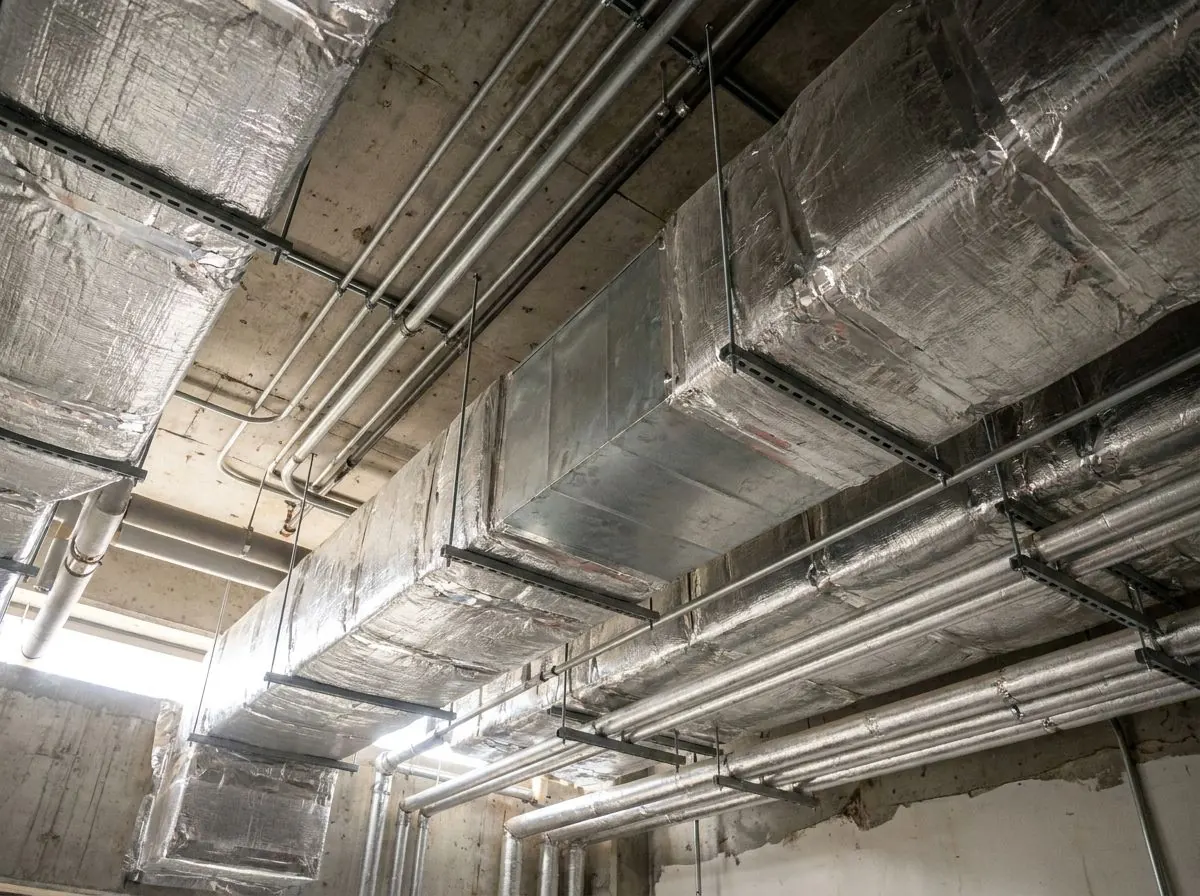
Most Oklahoma City homes run their supply and return ducts through a hot attic or a humid crawl space, where cold ducts sweat and gain heat all summer. We seal and wrap residential ductwork and install mechanical insulation and acoustic liner on commercial systems to the engineer’s specification.
The Problem It Solves
In a typical Oklahoma City house, the air handler sits in the attic and the ducts snake across the attic floor or lie buried in the insulation. On a summer afternoon that attic can run far hotter than the outdoor air, while the supply air inside the duct leaves the coil cold. Every foot of thinly insulated duct picks up heat before the air reaches the rooms, so the far bedrooms and the bonus room get the warmest, weakest air. The system runs longer and the thermostat rarely catches up on the hottest days.
Humidity creates the second problem. When the outside of a cold supply duct sits in humid air, moisture condenses on it whenever the duct surface drops below that air’s dew point. In vented crawl spaces under older pier-and-beam homes, and in attics during humid Gulf spells, that means ducts that drip. The water soaks the insulation, stains ceilings, rots subfloor and framing and feeds mold. Torn or gapped wrap is the usual cause, because humid air reaches the cold metal through the openings.
Leakage makes all of it worse. Older flex duct and sheet-metal runs often have loose connections at boots, takeoffs and the plenum. Supply leaks dump cooled air into the attic, and return leaks pull hot, dusty attic air or damp crawl air back into the system. Wrapping a leaky duct without sealing it first hides the leaks under insulation, where they keep wasting conditioned air and drawing in moisture for years.
How It Works
The fix runs in order: seal, then insulate. Joints, seams, takeoffs, boots and the plenum connections are sealed with mastic or listed tape so the duct holds air. Then the duct is wrapped with fiberglass blanket carrying an FSK facing, the foil-scrim-kraft jacket that acts as the vapor retarder. Wrap thickness is chosen for the location, with attic ducts in new work commonly at R-8. Sealed and wrapped ducts deliver air closer to the temperature it left the coil, and the outer surface stays warm enough that humid air no longer condenses on it.
The jacket must be continuous on any cold duct. Every seam, tear, hanger penetration and end is lapped and taped, because a single opening lets humid air reach the cold metal under the blanket, and that is where drips start. Inside the duct, acoustic liner can quiet fan and air noise near the air handler. In commercial work, ducts, plenums and chilled-water or refrigerant piping are insulated to the mechanical engineer’s specification, which sets thickness, jacket and fittings for each system.
How the Job Runs, Step by Step
Trace the system and find the sweating
We follow the supply and return runs from the air handler to each boot, noting duct type, existing wrap, crushed or kinked flex, disconnected joints and water staining. In crawl spaces we look for dripping ducts and wet ground. Disconnected ducts and drain problems go to the HVAC contractor first.
Seal joints, seams and boots
Takeoffs, seams, collars, boots and the plenum connections are sealed with mastic or listed foil tape, not cloth duct tape, which lets go in attic heat. Boots are sealed to the ceiling drywall so attic air cannot be drawn into the room. Sealing comes first because wrap would hide every leak afterward.
Wrap with a continuous FSK jacket
Duct wrap is cut to length, fitted without compressing it, and lapped at every seam with the facing outward. Laps are taped with FSK tape and fastened where needed so they stay closed in attic heat. Hangers, dampers and joints get the same treatment, because any break in the jacket on a cold duct is a future drip.
Insulate lines, liner and fittings as specified
Refrigerant suction lines and condensate lines are insulated where specified, with the jacket sealed at fittings. On commercial jobs, liner, board, wrap or pipe insulation goes on to the engineer’s schedule. Elbows, transitions and access doors are covered without blocking dampers or service panels.
Check clearances and record the work
We confirm wrapped ducts are supported off the attic floor or crawl ground where possible, that access panels and filter doors still open, and that no insulation sits against flues or heat sources. Photos and a list of what was sealed and wrapped go to the owner, the HVAC contractor and the inspector.
What Decides the Specification
Location decides most of the specification. Ducts in a vented attic face the largest temperature difference, so they get the thickest wrap, commonly R-8 in new work. Ducts in a vented crawl space face humid air close to their own temperature on many summer days, so jacket continuity matters most there. Ducts that run inside conditioned space, such as an unvented attic with foam at the roof deck, need far less insulation, though cold ducts may still need a vapor-retarding jacket.
On commercial systems the mechanical engineer sets the specification: thickness by duct or pipe size and service, jacket type, liner where noise matters, and fittings. Rooftop supply ducts, chilled-water lines, refrigerant piping and kitchen or exhaust systems each have different needs, and some, such as grease ducts, carry fire-rated wrap requirements that belong to their own listed systems. Our job on those projects is to install exactly to the schedule and submittals, then leave the work open for review before ceilings close.
Oklahoma Code Notes
For homes, the energy chapter of the 2024 IRC as adopted in Oklahoma, with state amendments (OAC 748:20-6-16), commonly calls for R-8 insulation on supply and return ducts 3 inches in diameter and larger located in attics in new work, with other values for ducts in other locations. Oklahoma amended the duct sealing section, N1103.3.6, to add requirements for return air and sheet-metal ducts, and permitted HVAC work is inspected against it by the city building department, such as the City of Oklahoma City’s Development Services or the City of Moore. For an existing home outside a permit, those values are a sensible benchmark rather than a legal requirement.
Commercial ducts and piping fall under the commercial mechanical and energy provisions the jurisdiction enforces, and the mechanical engineer’s specification names the insulation for each system, from rooftop supply ducts to chilled-water and refrigerant lines. We install to that specification and its approved submittals, and leave interpretation to the engineer and the building official. Where the schedule and the field conditions disagree, such as a duct with too little clearance for the specified thickness, we raise it before covering anything.
General guidance only. The city building department and the product’s own evaluation report decide what applies to your job.
Around Oklahoma City
Attic air handlers are the norm across the metro, from 1990s two-story homes in Edmond’s Fairfax and Rose Creek areas to the newer slab homes on Yukon’s west side, and long duct runs to second-floor rooms and bonus rooms are where summer complaints concentrate. In Midwest City’s 1940s–1960s brick ranch homes, original or early replacement ductwork often runs through the attic with thin wrap and loose joints, so sealing and rewrapping can noticeably change how evenly the house cools.
Older pier-and-beam homes in Oklahoma City neighborhoods such as Crown Heights often have ducts in a vented crawl space, where humid summer air meets cold supply ducts and the dripping begins. Wet wrap there sags off the duct, and the water lands on floor framing and the ground below. In those homes the duct work is often paired with a crawl space vapor retarder or encapsulation, because the moisture in the crawl air drives the problem.
Often Done Alongside
Commercial Firestopping
Tested and listed firestop systems for penetrations and joints in rated assemblies.
Attic Air Sealing & Penetration Proofing
Hand-sealing attic penetrations, top plates, duct boots and the HVAC platform.
Commercial Bay & Warehouse Spray Foam
Closed-cell foam sprayed straight onto steel roofs and walls in commercial bays.
Where We Do This Work
Duct Insulation: Questions We Get
Why do the ducts in my crawl space drip in summer?
Is R-8 duct wrap required in my attic?
Can you add acoustic liner to quiet a noisy system?
Do you insulate commercial ductwork and piping?
Do I need a permit for insulation work?
Considering Duct Insulation?
Tell Spray Tech Insulation about the job. We will look at it, tell you whether duct insulation is the right fix, and price it in writing.