Moore, OK Insulation Contractor for Ranch Homes and Newer Rebuilds
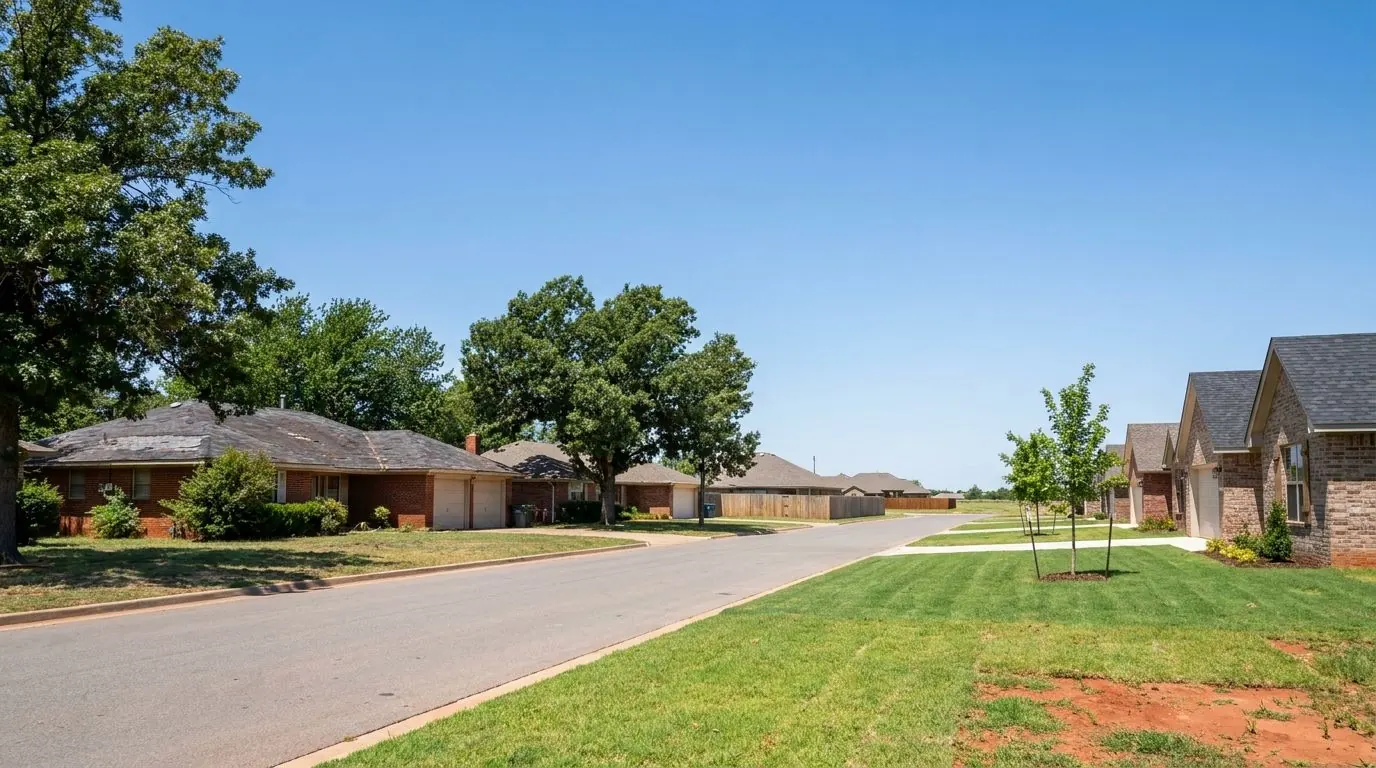
Moore’s housing comes in two broad layers. Most of the city is single-story brick ranch homes from the 1960s onward, and threaded through it are blocks rebuilt after the 2013 tornado, where a newer house can stand beside one fifty years older. The two need different work, sometimes on the same street.
At a Glance
- Permits issued by
- City of Moore
- From central OKC
- About 15-20 minutes south on I-35
- Main ZIP codes
- 73160, 73165, 73170
The Homes and Buildings in Moore
The backbone of Moore is the ranch home: one story, brick veneer over wood framing, a slab on the area’s expansive clay, and an attic that holds the furnace or air handler and the duct trunk. Built largely from the 1960s through the 1980s, these houses commonly carry whatever attic insulation went in at construction plus, in some cases, one top-up since. That layer has settled, been pushed aside around the HVAC equipment and been crushed where people walk to the filter. The soffits on many of these ranches are closed or under-vented, so before adding fill we check that the attic can actually breathe at the eaves and install baffles where it cannot.
Moore was struck by major tornadoes in 1999 and again on 20 May 2013, and many homes in the 2013 path were rebuilt in the years that followed. That is why parts of the city have a cluster of houses built to a more recent code edition, often two-story with a bonus room or an open plan with vaulted ceilings. These newer homes rarely need a full attic top-up. The more likely problems are construction-stage misses: batts that never reached the subfloor over the garage, knee walls left open to the attic, and duct boots that were never sealed to the drywall.
Many Moore homeowners have also added a storm cellar or safe room, some below grade and some in the garage. Below-grade rooms can stay damp in summer and smell musty. Closed-cell foam can help on dry concrete, but it is a humidity and comfort measure only, and it does nothing to change how the room performs in a storm. If the cellar is dry and you rarely spend time in it, leaving it alone is reasonable.
Neighborhood Notes
Old Town Moore
The oldest part of the city, with smaller homes that predate most of the city and many renovations layered on top. Attics often have mixed layers of old insulation and unsealed penetrations from decades of wiring changes, so air sealing comes before anything else.
Around Southmoore
Established neighborhoods of ranch homes in this part of Moore. Settled attic fill, crushed paths around the furnace and blocked soffits are common. A blown cellulose or fiberglass top-up after sealing is usually the most useful step.
Post-2013 rebuild blocks
Streets where homes were rebuilt after the 2013 tornado, sitting beside older houses that were not. The newer homes typically need targeted work: bonus-room floors, knee walls and duct boots rather than a whole-attic job.
1960s–80s ranch streets
The broad middle of the city’s housing. Brick veneer ranches with attic HVAC and older ductwork. Duct sealing and wrap, attic air sealing and baffle installation tend to come up together on these houses.
Newer east-side subdivisions
Recent slab homes on the east side, built to more current code editions. Attics are usually reasonable, so the useful work is often a thermal scan to find specific misses, garage insulation or an upstairs room that runs hot.
Permits in Moore
Authority having jurisdiction: City of Moore
The City of Moore issues building permits for homes inside its limits. An addition, a remodel or a new house carries its own permit, and the insulation inside that work gets inspected along with everything else. A stand-alone attic top-up or duct job is a different question, and the answer belongs to the city, so we ask rather than guess. A storm cellar or safe room installation is its own permitted project with its own rules; insulating an existing one is a separate question for the City. Homes past the city line in unincorporated Cleveland County should check with Cleveland County instead.
What Moore Homes and Buildings Need Most
Blown-In Loose-Fill Fiberglass
Light, non-settling loose-fill fiberglass, with wind dams to protect the eaves.
Attic Air Sealing & Penetration Proofing
Hand-sealing attic penetrations, top plates, duct boots and the HVAC platform.
Attic Venting & Baffle Prep
Rafter vents and wind dams that keep soffit-to-ridge airflow open.
Ductwork & HVAC Thermal Wrap
Duct wrap, liner and mechanical insulation that stops sweating and heat gain.
Bonus Rooms Over Garages
Fixes for a bonus room that won’t cool in summer or stay warm underfoot in winter.
Insulation in Moore: Questions
Our Moore house was rebuilt after 2013. Why would it need insulation work already?
Can you insulate our storm cellar so it doesn’t smell musty?
Is blown fiberglass or cellulose better for a Moore ranch attic?
Insulation Work in Moore?
Tell us the address and what is going on. Spray Tech Insulation works across Moore and the surrounding area, and we will tell you what the job needs before we price it.