Pole Barn, Ag Shop and Steel Building Spray Foam Around Oklahoma City
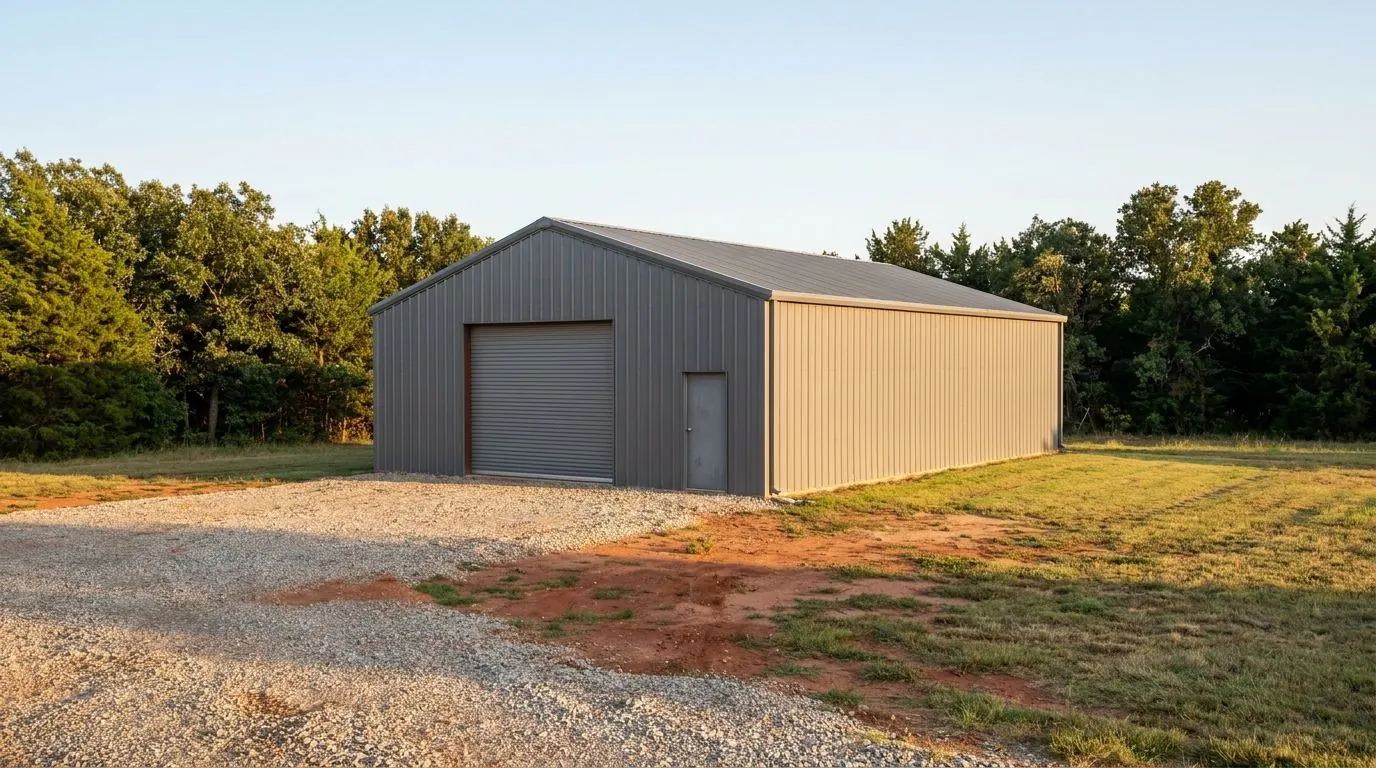
Post-frame and steel-clad buildings sweat under the roof steel, drip on equipment and hay, and bake in July. We spray closed-cell foam directly to the steel in pole barns, acreage shops and barndominium-style buildings around Oklahoma City, with ventilation planned for the way the building is used.
The Problem It Solves
A pole barn or steel shop is a skin of thin metal over a frame, and that skin follows outdoor temperature closely. On a clear night the roof steel radiates heat to the sky and cools below air temperature. Any moisture in the air underneath, from damp ground, a wet slab, livestock, a running heater or simply a humid Oklahoma evening, condenses on the underside of the panels. By morning it drips onto tractors, trucks, hay, tools and workbenches. Over a few seasons that sweating rusts fasteners, stains everything below and rots wood purlins and posts.
Summer is the other half of the problem. Bare steel under an Oklahoma sun gets hot enough to burn a hand, and it radiates that heat down into the building. A shop that is pleasant at seven in the morning can be hard to work in by noon, and a mini-split or window unit sized for an ordinary room cannot keep up with an uninsulated roof. Equipment, batteries and paint suffer in that heat, and so do the people working there.
The usual first fix makes things worse over time. Fiberglass batts or vinyl-faced blanket stapled between girts and purlins leave gaps at every framing member, and humid air finds the steel behind them. The fiberglass gets wet, sags and grows mold. Birds pull it out for nests and mice tunnel through it, so within a few years the insulation hangs in strips. In livestock buildings, ammonia and high humidity speed all of that up and corrode exposed steel and fasteners.
How It Works
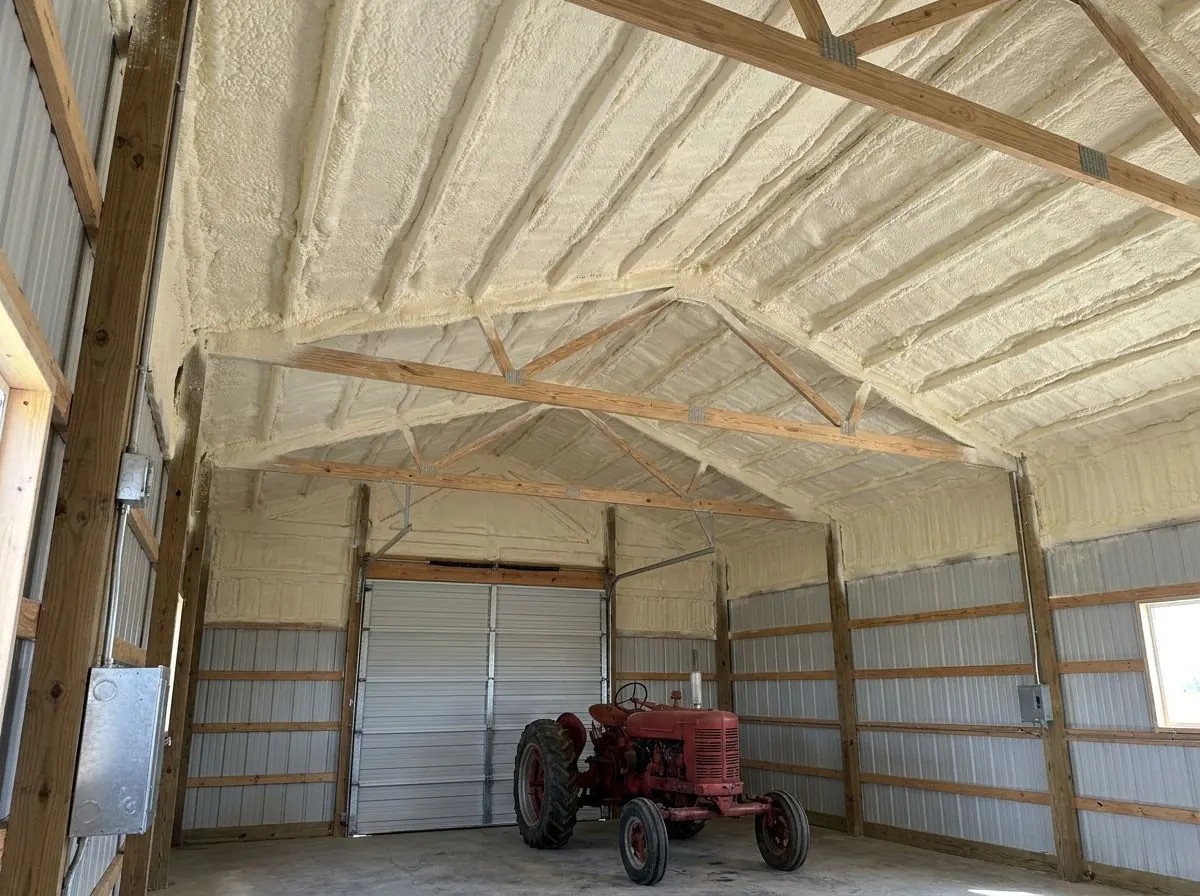
Closed-cell spray foam bonds directly to the steel and fills the ribs of the panels, so humid air never reaches the cold metal. The surface that air now meets is the inside face of the foam, which stays close to the temperature inside the building, and the dripping stops. The same layer seals the laps, screw holes and gaps at the eaves and base trims where wind, dust and insects get in. Because closed-cell foam resists water uptake and gives pests nothing loose to pull at, it holds up in barns where batts fail.
In summer the foam slows the heat moving down from the roof, which makes a fan, a mini-split or a modest heating and cooling system practical in a shop that could never be kept comfortable before. Thickness is set by the goal. An unheated equipment barn may only need enough to stop condensation. A heated and cooled workshop or a barndominium living area needs more, and its interior finish or coating has to suit a space where people spend their days.
How the Job Runs, Step by Step
Find out what the building really does
Equipment storage, a heated woodworking shop, horses, a hay barn or a living space each need a different plan. We ask about heating, cooling, animals, wash bays and how often doors stand open, then check the roof for leaks, rusted panels and loose fasteners that need repair before anything is sprayed.
Clean the steel and protect the contents
Old batts and torn blanket come out and are bagged. Steel is cleaned of dust, bird droppings, oil and loose rust, and primed if the foam manufacturer calls for it. Vehicles, hay and tools are moved out or covered, and lights and windows masked.
Spray roof steel, girts and end walls in lifts
Foam goes on in passes no thicker than the manufacturer’s per-pass maximum, working across the roof steel, down the wall panels and around overhead door headers and eaves. The building is ventilated during spraying, and people and animals stay out until the manufacturer’s re-occupancy time, commonly about a day.
Detail doors, eaves and ventilation openings
Sliding and overhead door frames, eave closures, ridge vents and wall louvers are where barns leak air and water. Foam is trimmed back from vents and moving parts, so ventilation keeps working and doors still close.
Apply the protection the use calls for
Where the foam’s evaluation report and the building’s use call for a thermal or ignition barrier, the accepted coating goes on at its stated thickness, or the owner arranges a liner or drywall. We note foam and coating thicknesses so the owner, an insurer or a later buyer knows what was installed.
What Decides the Specification
The building’s use drives the thickness and the finish. A cold equipment shed needs enough foam to stop sweating under the steel. A conditioned shop or barndominium living area needs a higher R-value and protection suited to occupied space, typically drywall or a liner, or an intumescent coating that the foam’s evaluation report accepts for that exposure. Hay, fuel, welding and wood stoves raise the stakes on fire protection, so we discuss them first.
Framing and existing materials matter too. Wood purlins and posts take foam well but must be dry. Steel girts conduct heat, so they are foamed over rather than left as cold lines. Where the slab or ground is a big moisture source, a vapor retarder under a new slab, or managing a dirt floor, helps the foam do its job. Livestock buildings need corrosion-aware fasteners, ventilation sized for the animals, and foam kept out of reach or covered where animals could chew it.
Oklahoma Code Notes
How permitting applies to a barn or shop depends on where it stands and how it is used. Building codes and local permit offices often treat genuine agricultural buildings differently from other structures, especially in unincorporated areas, but that treatment is not automatic and it varies from one jurisdiction to the next. A building inside a city such as Choctaw, Norman or Yukon falls to that city’s building department; for an unincorporated address, check with the county. A barndominium or any building people live in is a dwelling under the 2024 IRC as adopted in Oklahoma, with state amendments, and the living area is treated as such. Whatever the permit status, foam plastic still needs the thermal or ignition protection its evaluation report requires, and your insurer may have its own requirements, so confirm with both.
General guidance only. The city building department and the product’s own evaluation report decide what applies to your job.
Around Oklahoma City
Choctaw’s large-lot, semi-rural east side is full of this work: horse properties, hobby shops, equipment barns and steel buildings that have been turned into workshops or partly into living space. East Norman toward Lake Thunderbird has a similar mix of acreage shops and barns, where the shade is thin and summer heat under the roof steel is the first complaint. Rural Canadian County acreages west of the metro add open prairie exposure, so wind-driven dust and rain test every eave and lap.
Across all of them the seasonal pattern is the same. Humid spells when Gulf moisture moves north bring on heavy sweating, and sharp arctic outbreaks in winter turn a dripping roof into frost that melts onto everything below when the weather breaks. Closed-cell foam on the steel addresses both, because it removes the cold metal surface in either season. Before anything is sprayed we check whether the building is used for animals, hay or fuel, because those uses change the plan.
Often Done Alongside
Commercial Bay & Warehouse Spray Foam
Closed-cell foam sprayed straight onto steel roofs and walls in commercial bays.
Detached & Heated Garages
Full garage and shop envelopes for unit heaters, infrared tubes or mini-splits.
Intumescent Thermal Barrier Coating
Listed intumescent coatings over exposed foam where drywall won't work.
Where We Do This Work
Ag Shops: Questions We Get
How thick should spray foam be in a pole barn?
Is spray foam safe to use in a horse barn?
Does a farm building on my acreage need a permit to insulate?
Will foam keep my shop cool in an Oklahoma summer?
Can you insulate an Oklahoma attic in the middle of summer or winter?
Considering Ag Shops?
Tell Spray Tech Insulation about the job. We will look at it, tell you whether ag shops is the right fix, and price it in writing.